BY THE EDITORS |
Keia Clarke on Growing the New York Liberty Beyond the Game
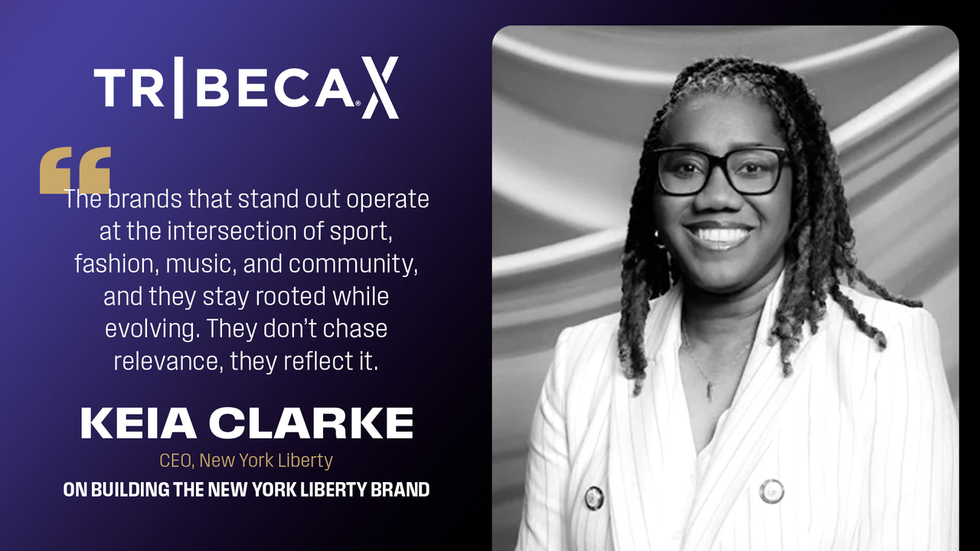
We sat down with Keia Clarke — CEO of the New York Liberty and one of the most forward-thinking executives in women's sports — to talk about what it actually takes to build a franchise into a cultural institution: how to pursue mainstream visibility without sacrificing your identity, why owning your narrative matters as much as broadcast reach, and what she's learned from transforming the Liberty into a brand that New York didn't just accept, but fell in love with.
Tribeca X returns June 8-9, and passes are now on sale. This year, Clarke will join Phil Cook from the WNBA and National Women's Soccer League CMO Rachel Epstein for a conversation about what comes after the momentum, and what will define the next era of women's sports. You won't want to miss it.
Read the interview below—then get your pass for Tribeca X.
The following interview has been condensed for clarity.
Tribeca X: Before the 2024 season, you negotiated a landmark distribution deal with WNYW FOX5 New York — the network's first-ever partnership with a women's professional sports team — reaching more than 7.5 million households across the Tri-State area. You also led the launch of Liberty Live, the team’s own direct-to-consumer streaming platform.
Walk us through that process. What storytelling opportunities do those platforms unlock that your brand couldn't access before?
Clarke: The starting point for us was access — who gets to see these athletes, these stories, and this brand at scale. For a long time, that access was limited, and we knew that if we wanted to build a generational fanbase, we had to meet fans where they are. The FOX5 partnership was about mainstream visibility. It put the Liberty into millions of homes in a way that felt normalized — like you’d expect for any major New York team. At the same time, Liberty Live gave us something equally important: ownership of our narrative.
That combination changed how we show up. Broadcast gives you reach, but direct-to-consumer gives you control, flexibility, and proximity to your audience. Now we can tell stories that don’t live within the constraints of a game window — behind-the-scenes, player personalities, cultural intersections.
And when you combine both — mass reach and owned storytelling — you build something much bigger than a team. You build a brand people engage with every day, not just during the season.
Tribeca X: Women's basketball has historically been overlooked in mainstream sports media. But in 2024, the Liberty set the WNBA's all-time single-game gate receipt record — twice. Is that the result of deliberate brand strategy, or did something shift in culture that you caught and amplified?
Clarke:It’s both. There’s absolutely been a cultural shift. Women’s sports are finally being recognized for what they’ve always been: elite, compelling, and culturally relevant. But recognition alone doesn’t drive record-breaking attendance. Intentional strategy and consistent execution do.
When we came to Brooklyn, we made a decision early on to invest like we believed this would work — in the players, the facilities, the fan experience, and critically, in storytelling. We didn’t wait for validation.
So when the cultural moment accelerated, we didn’t need to create it — we were already positioned to capture it and scale it. We had built a product that people wanted to be part of. What we’re seeing with attendance isn’t just demand for basketball, it’s a desire for an experience, for community, and to be part of a brand that reflects the energy and diversity of New York.
Tribeca X: the Liberty's visual identity, in-arena experience, and social presence feel different from most WNBA teams. How intentional was that, and how do you ensure the brand story holds together across every touchpoint — from broadcast to a player's Instagram to the experience inside Barclays?
Clarke: It’s extremely intentional, but it starts with something simple: knowing who you are. For us, that’s rooted in authenticity, inclusivity, and being unapologetically New York. Once that was clear, every decision became a reflection of those values — from the gameday experience to the stories we tell to the merchandise we create. The same energy you feel walking into Barclays Center should translate to what you see on Instagram or how our games show up on broadcast.
And a big part of that is trust — trusting our players, our partners, and our team to express the brand and evolve it in real time. New York moves fast, and so do we. Consistency doesn’t come from control. It comes from clarity, alignment, and shared ownership of the brand.